
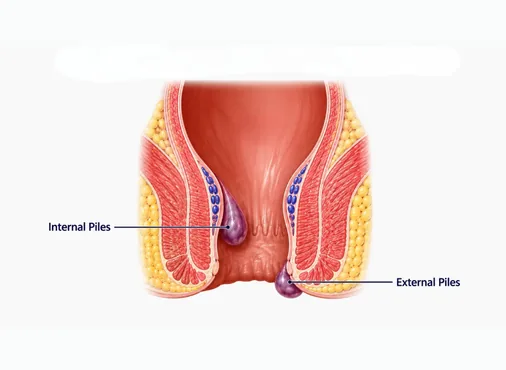
Direct answer
Piles, fissure and fistula are different problems around the anus. Bright bleeding with a lump is often piles. Sharp pain while passing stool suggests a fissure. A boil that keeps discharging near the anus is often a fistula. If bleeding, pain or discharge lasts more than a few days, book a surgical review. At Niraaya Hospital, Kudasan, Dr Neel Patel treats suitable patients with medicines, and with laser, stapler or conventional surgery when a procedure is needed.
Key points
- Piles, fissure and fistula need different treatment. Self-diagnosis often delays the right care.
- Hard stools, straining and long sitting make all three worse.
- Heavy bleeding, fever, or a painful swelling that is growing needs same-day review.
- Many early piles and acute fissures settle with medical care. Chronic fistula usually needs a procedure.
What is the difference between piles, fissure and fistula?
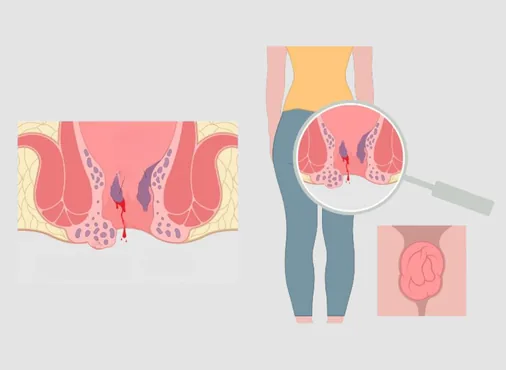
Piles, also called hemorrhoids, are swollen cushions of tissue inside or just outside the anal canal. They often cause bright red bleeding, a feeling of something coming down, itching, or a soft lump. Pain is more common when an external pile clots.
An anal fissure is a small tear in the anal lining. The usual clue is sharp pain during and after a bowel movement, sometimes with a streak of blood on the stool or paper.
An anal fistula is a tunnel from inside the anal canal to the skin. It often follows an abscess. Patients notice repeated discharge, staining of clothes, or a boil that bursts and then returns.
A simple way to think about grades of piles
- Grade 1: bleeding, no prolapse
- Grade 2: the tissue comes down and goes back on its own
- Grade 3: it has to be pushed back
- Grade 4: it stays outside
Grade alone does not decide surgery. Symptoms, bleeding, and the examination do.
When should you see a piles specialist in Gandhinagar?
See a surgeon if bleeding lasts more than a few days, a lump is new or growing, pain stops you from sitting or working, or discharge keeps returning. People in Kudasan, Gandhinagar and Ahmedabad can be assessed at Niraaya Hospital without travelling across the city for a first opinion.
New rectal bleeding after 40, black stools, unexplained weight loss, or a change in bowel habit also need a proper check. Piles are common, but they are not the only cause of bleeding.
What can be tried before surgery?
- More water and fibre, so stools stay soft
- Less straining and less time on the toilet
- Short courses of local medicines when prescribed
- Treatment of constipation or diarrhoea, whichever is driving the problem
An acute fissure often heals this way. A fistula rarely closes fully on its own once a tunnel has formed.
How does Dr Neel Patel choose laser, stapler or conventional surgery?
There is no single best operation for every patient. After examination, and a proctoscopy when needed, the plan matches the problem:
- Laser procedures suit selected piles, chronic fissures and some fistulas, with small wounds and a short hospital stay for many people.
- Stapler surgery is considered for circumferential piles that prolapse.
- Conventional surgery remains a sound choice for large external disease or complex fistula tracts that involve more sphincter muscle.
Protecting continence matters as much as closing the disease. That is why fistula surgery is planned, not rushed into a one-size cut. Read the full service outline on our piles, fissure and fistula page.
Recovery in brief
Many elective piles procedures are day-care or one-night stays. Expect some pain and spotting in the first week. Soft stools, sitz care as advised, and the follow-up visit matter more than any home remedy shared online. Most people return to desk work within a few days. Heavy work and cycling wait until the wound is comfortable.
Frequently asked questions
Can piles heal without surgery?
Many early piles and an acute fissure improve with softer stools and prescribed medicines. Prolapsing piles, repeated bleeding, and an established fistula usually need a procedure if they keep returning.
Is laser piles surgery available in Gandhinagar?
Yes. For suitable patients, Dr Neel Patel offers laser piles treatment at Niraaya Hospital, Kudasan, along with stapler and conventional surgery when those fit better.
How do I know if it is a fissure or piles?
Fissure pain is typically sharp and tied to passing stool. Piles more often cause bleeding and a lump, with less cutting pain unless a clot has formed. Only an examination can tell them apart reliably.
Is a fistula dangerous if I ignore it?
A fistula can keep forming abscesses. Repeated infection makes later surgery harder. It should be mapped and treated rather than drained at home.